
- 中文
- English
Structure principle of photodiode and detection method
Time: 2022-04-27 00:00:00
Author: HONWAY
Click:
A photodiode is an optoelectronic device that uses a silicon PN junction to generate a photocurrent after being illuminated. The structure of a photodiode is similar to that of an ordinary semiconductor diode. Some photodiodes have an additional shield grounding pin to improve their stability and resemble a phototransistor in appearance. Photodiodes operate on reverse bias, and their spectral response characteristics are mainly determined by the concentration of impurities doped in the semicondu
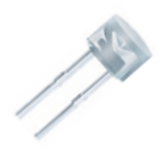
A photodiode is an optoelectronic device that uses a silicon PN junction to generate a photocurrent after being illuminated. The structure of a photodiode is similar to that of an ordinary semiconductor diode. Some photodiodes have an additional shield grounding pin to improve their stability and resemble a phototransistor in appearance. Photodiodes operate on reverse bias, and their spectral response characteristics are mainly determined by the concentration of impurities doped in the semiconductor material.
Photodiodes are designed and fabricated to make the area of the PN junction as large as possible in order to receive incident light. Photodiodes are working under the action of reverse voltage, no light, the reverse current is extremely weak, called dark current; when there is light, the reverse current quickly increased to tens of microamps, called photocurrent. The greater the intensity of light, the greater the reverse current. The change of light causes the photodiode current change, which can convert the light signal into an electrical signal, and become a photoelectric sensor device.
Photodiode in a certain reverse bias voltage, the same intensity and different wavelength of incident light irradiation, the photocurrent generated is not the same, but there is a maximum value. The maximum value of photocurrent produced by the photodiode under the same reverse bias voltage and the same intensity of incident light irradiation is also different, and the wavelength of incident light corresponding to the maximum value of photocurrent is also different.
When the light through the skylight or glass convex mirror on the PN junction, due to the absorption of light energy site, so that the PN junction near the escape of a large number of free electrons, correspondingly, the same number of holes, with a free electron hole pairs continue to increase, the photocurrent is also increasing. The value of photocurrent is proportional to the illumination level.
The PN junction of the photodiode is set on the internal tomb of the transparent shell, which can receive light through a transparent skylight or glass convex mirror, and it uses reverse bias connection in the circuit.
When measuring the photodiode, first use black paper or black cloth to cover the light signal receiving window of the photodiode, and then use the multimeter R × 1k file its positive and negative resistance. When normal, the forward resistance value between 10 ~ 20kΩ, the reverse resistance value of ∞ (infinity). Then remove the black paper or black cloth, so that its light signal receiving window aligned with the light source, the normal positive and reverse resistance values will become smaller, the greater the change in resistance value, the higher the sensitivity of the photodiode, photodiode work with reverse voltage, no light, its reverse resistance is very large, only a very weak reverse saturation current. When there is light, it will produce a large reverse current (bright current), the stronger the light, the brighter the current is.

点击右上角
分享给朋友吧







 Long by picture save/share
0

Address: No. 7 Longshan Road, Taihu County Economic Development Zone, Anhui Province
Address: No. 188 Miaohong Road, Changshu City, Jiangsu Province
Consulting hotline:
0512-5267 9888
0556-4177 999

Address: No. 7 Longshan Road, Taihu County Economic Development Zone, Anhui Province
Address:No. 188 Miaohong Road, Changshu City, Jiangsu Province
Fax: 0512-55171795
Consulting hotline:
0512-5267 9888
0556-4177 999
Follow
—
Copyright HOIVWAY All rights reserved Su ICP No.18029291
